
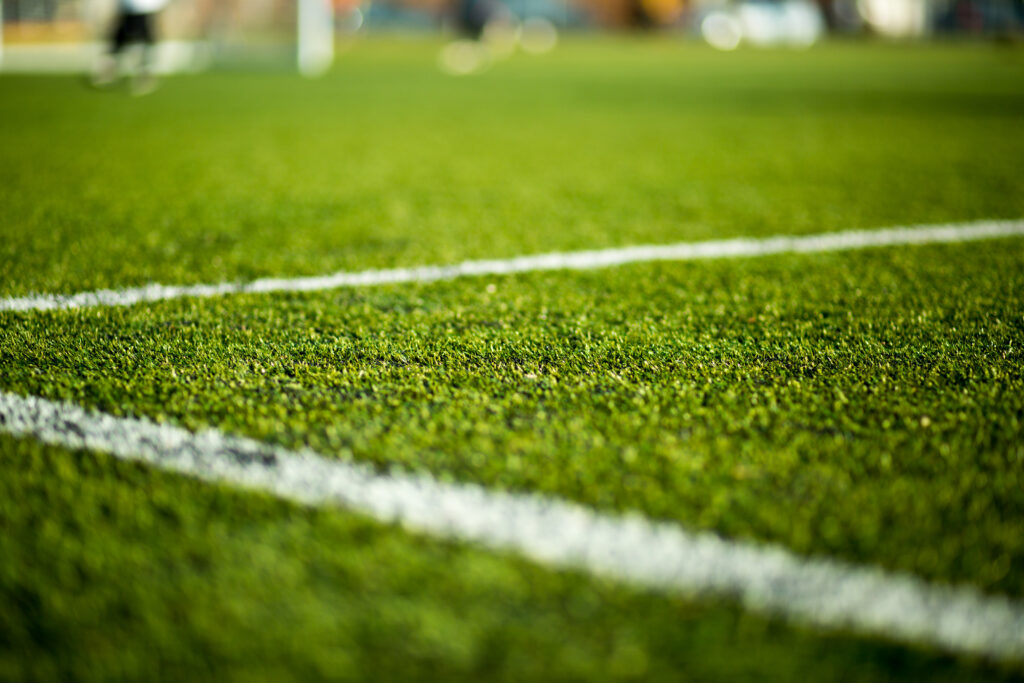
The widespread adoption of artificial turf as a sports surface has transformed facility management in municipalities and clubs. Its durability, versatility and stability make it a strategic alternative to natural turf, especially in high-demand areas. However, ensuring that a field maintains its performance is not solely a matter of design or material quality: maintenance is the decisive factor in preserving the safety, performance and longevity of the surface.
With this premise, at the IBV’s Sports Testing Lab we conducted a technical study in collaboration with the Provincial Council of Barcelona, with the aim of objectively quantifying the real impact of maintenance on heavily used artificial turf field.
The project was carried out across six football fields in different municipalities of the province of Barcelona. These facilities represented diverse situations in terms of age, usage intensity and state of conservation, allowing us to capture a representative picture of the region’s real conditions.
The study followed a three-phase protocol:
- Initial diagnostics using standardised tests and IBV’s own methodologies.
- Implementation of maintenance interventions, including decompaction, brushing, infill adjustments and, in one case, joint repair.
- Follow-up assessment by repeating the tests to objectively measure changes.
The parameters analysed fell into two key categories:
• Functional, such as shock absorption, vertical deformation, rotational resistance, drainage and ball behaviour.
• Construction-related, such as fibre length and verticality, or infill depth.
All measurements were carried out in accordance with UNE standards and validated scientific protocols, combining on-site assessments with laboratory analysis.
The findings were conclusive: maintenance significantly improves both the functional and construction-related properties of the fields, particularly in terms of player safety. Below are some of the results obtained:
a. After the interventions, parameters such as shock absorption and vertical deformation showed clear improvements. These properties—essential for cushioning player–surface interactions—became more stable across all fields, including the oldest ones. However, those with higher levels of wear did not fully return to normative ranges, indicating that maintenance enhances safety but cannot completely compensate for advanced deterioration in ageing surfaces.
b. Ball roll and rebound also responded positively to maintenance. Decompaction reduced resistance to ball movement, improving playability. Rebound values remained within normative limits and became more consistent.
c. Permeability increased consistently across all surfaces, improving water drainage.
d. Surface regularity improved after correcting defects such as open joints.
e. Fibre verticality and infill depth increased following brushing interventions, contributing to an extended service life of the surface.
Beyond safety and performance, the study also examined the economic return of maintenance. Comparisons between different scenarios demonstrated that:
• Not maintaining the field leads to replacement within just 5 years, with an estimated annual cost of up to €43,000.
• Periodic maintenance doubles the service life, reducing the annual cost to €21,500.
• Enhanced maintenance can extend service life to 15 years, lowering the average annual cost to €14,333.
Maintenance, therefore, is not merely a recommended technical action, but a strategic investment that reduces public expenditure and promotes the sustainability of sports facilities.
In conclusion, the study carried out by the IBV Sports Testing Lab shows that proper maintenance of artificial turf surfaces not only enhances performance, but is the most effective means of extending their service life, reducing injuries and optimising public resources.
This work reinforces the importance of implementing regulated maintenance plans and periodic assessments based on standardised testing. Maintenance science enables public administrations, clubs and sports facility managers to make objective decisions focused on safety, efficiency and long-term sustainability.