
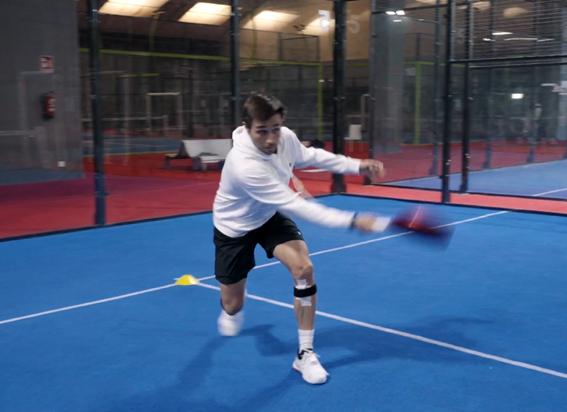
Padel has established itself as one of the fastest-growing sports worldwide. Its explosive nature—combining accelerations, sudden stops, rapid turns and repeated strokes—makes it a highly demanding discipline from a physical perspective. In this context, understanding how players interact with equipment and playing surfaces becomes essential for advancing both performance and safety in the sport.
In this regard, IBV, through its Sports Testing Lab, has spent recent years developing and applying scientific methodologies to analyse these interactions. This work has generated objective knowledge that is helping shape the future of padel, addressing key aspects such as the characteristics of playing surfaces, footwear behaviour, racket design and player biomechanics.
Playing surfaces: understanding the relationship between friction, stability and physical load
Padel surfaces play a decisive role in both safety and playing experience. Properties such as friction, shock absorption, energy restitution and stability directly influence a player’s ability to accelerate, brake and change direction.
Through field testing and real-time biomechanical assessments—conducted with both amateur and professional players—it has been possible to quantify how different levels of friction modify lower-limb loading and stability during movement.
These analyses have shown that achieving a balance between stability and movement fluidity is key to reducing injury risk without compromising performance, providing a scientific foundation for the development of safer and more efficient surfaces.
Footwear: assessing a critical factor for safety and performance
Padel footwear must withstand high forces and multidirectional movements. In this area, IBV’s Sports Testing Lab has specific methodologies to evaluate factors such as weight, flexibility, cushioning, traction and energy return capacity.
In addition to mechanical and laboratory measurements, tests with real users complement the evaluation by analysing parameters such as comfort, perceived stability and fit. This comprehensive approach makes it possible to understand how a shoe behaves under real playing conditions, offering valuable insight for design and optimisation.
The role of padel rackets in vibration transmission and injury prevention
The racket is another key element in player biomechanics. Characteristics such as weight, stiffness, mass distribution, friction and sweet-spot size influence both stroke efficiency and the loads transmitted to the arm.
In this field, IBV’s Sports Testing Lab has analysed the vibration generated after impact and its transmission towards the wrist and elbow—an essential aspect in preventing common injuries such as epicondylitis. Identifying the vibrational behaviour of different rackets allows the establishment of criteria for safer and more ergonomic designs.
Player biomechanics: measuring to understand and improve
Movement analysis using markerless technologies, combined with force platforms and advanced capture systems, provides a comprehensive view of player behaviour during real game actions.
These tools, available at IBV’s Sports Testing Lab, allow for the study of technique, the detection of patterns that may generate overload, and the establishment of objective performance indicators. Additionally, the ability to obtain results in real time facilitates learning and immediate correction, helping improve movement efficiency and reduce injury risk.
Conclusion
At IBV we have demonstrated that biomechanics is an essential tool for advancing the quality, safety and performance of padel. Applied research on surfaces, footwear, rackets and player biomechanics provides a solid foundation for decision-making, product development and the definition of future standards in the sport.